

Why Choose Your Clinic in North Logan for IVF?
Conceptions Fertility Center in North Logan, UT, led by Andrew K. Moore, M.D., offers advanced IVF treatments with a personalized touch. The clinic combines state-of-the-art technology and years of experience to provide tailored fertility solutions designed to meet the unique needs of each patient. Our team works closely with you, ensuring that every aspect of your IVF journey is managed with care, precision, and support. For more information, contact us or book an appointment online. We are conveniently located at 2245 N 400 E Suite 201, North Logan, UT 84341.
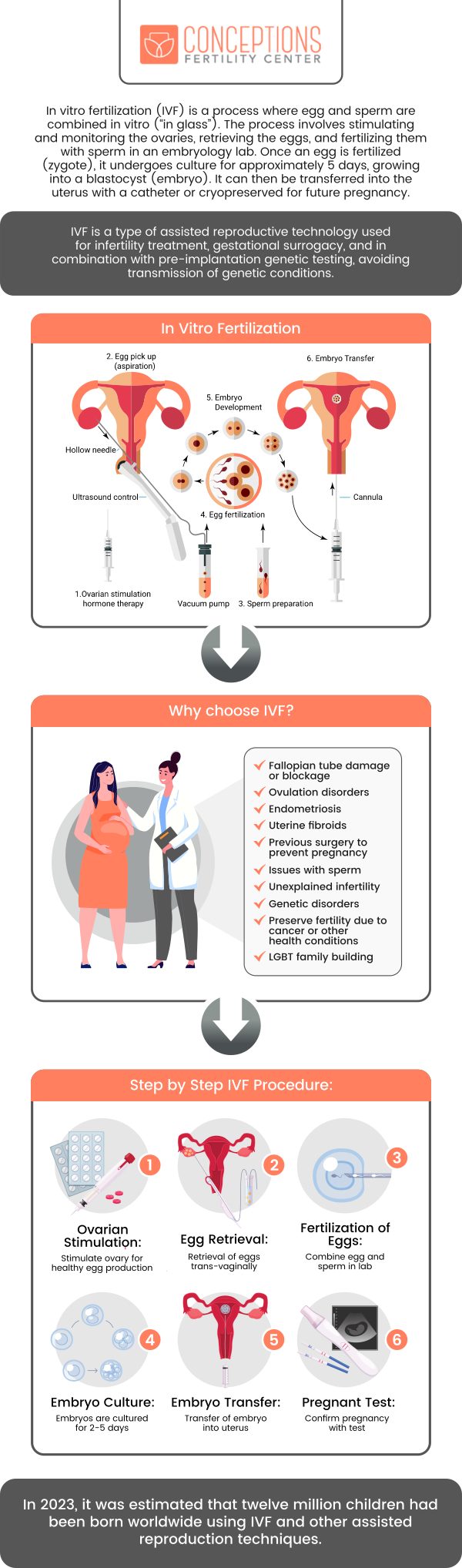
Table of Contents:
What are the steps of a complete IVF cycle?
How many monitoring visits will I need during the cycle?
What are your IVF success rates in North Logan?
How do age, ovarian reserve, or medical conditions affect IVF success?
Dr. Moore’s Commitment: Why Our North Logan Clinic is Dedicated to Your Personalized IVF Success
A complete IVF cycle involves several closely coordinated steps designed to support fertilization and embryo development outside the body before transfer to the uterus. While individual protocols may vary slightly based on your medical needs, the main stages of IVF include:
First, ovarian stimulation and monitoring. Using carefully calibrated hormonal medications, your reproductive system is stimulated to produce multiple mature eggs rather than the single egg typically released in a natural cycle. During this period, you will visit the clinic regularly for ultrasounds and blood tests to check follicle growth and hormone levels.
Next, egg retrieval is performed under light sedation in a comfortable clinical setting. Using ultrasound guidance, the physician retrieves mature eggs from the ovaries. This is a minimally invasive procedure and allows the lab team to access multiple eggs in one session.
Immediately following retrieval, fertilization takes place in the embryology lab. Eggs are combined with sperm from your partner or a donor to create embryos. Depending on your plan and medical history, fertilization may be achieved through conventional insemination or intracytoplasmic sperm injection (ICSI), where a single sperm is placed directly into an egg.
Once embryos are created, they are monitored over several days for development and quality. Some patients choose to have genetic testing (PGT) performed on embryos to screen for chromosomal abnormalities, improving the chances of a healthy pregnancy.
Finally, a selected embryo (or embryos, based on clinical guidance and personal choice) is transferred to the uterus. This procedure is typically quick and performed without anesthesia. If the embryo implants successfully, pregnancy begins. Excess healthy embryos can be cryopreserved (frozen) for future attempts, reducing the need to repeat the full stimulation process.
Each step requires careful coordination and support, and your clinical team will guide you through the timeline, expectations, and decisions at every stage.
Monitoring is a vital part of IVF because timing is crucial. The number of clinic visits varies by individual response, age, and specific protocol, but most patients can expect several visits across the stimulation and monitoring phase.
During ovarian stimulation, you will undergo serial ultrasounds and blood tests approximately every two to three days. These visits allow your fertility specialist to track follicle growth and hormone levels so that medication doses can be adjusted as needed. Some patients require more frequent monitoring, especially if their ovaries respond quickly or slowly to stimulation. The timing of egg retrieval depends on achieving optimal follicular development, which is why real‑time monitoring is essential.
Additional visits may occur after embryo transfer to check hormone support and confirm pregnancy with a blood test. While frequent monitoring can feel demanding, it significantly increases the likelihood of a well‑timed retrieval and enhances the overall effectiveness of the IVF cycle.
At Conceptions Fertility Center in North Logan, IVF success is a priority, and we are committed to transparency and individualized expectation setting. Success rates depend on multiple variables and are typically reported based on pregnancy rates, live birth rates, and age‑stratified outcomes.
Because fertility outcomes vary widely depending on factors such as age, ovarian reserve, sperm quality, and underlying health conditions, we evaluate your personal prognosis before estimating your likelihood of success. Rather than relying on broad statistics, we use clinic data and evidence‑based protocols to model expected outcomes tailored to your specific profile.
During your consultation, Dr. Moore will discuss how success rates apply to you, drawing on the most recent clinical data available. This personalized approach helps ensure you are informed, prepared, and supported throughout your IVF experience.
Age is one of the most significant factors influencing fertility and IVF success. As women age, both the quantity and quality of eggs decline, which can affect fertilization rates, embryo development, and implantation potential. For this reason, patients in their early 30s often have higher success rates compared to those in their late 30s and beyond. However, age is just one part of the picture.
Ovarian reserve, a measure of the number and health of eggs remaining in the ovaries, also plays a major role. Tests such as anti‑Müllerian hormone (AMH) levels and antral follicle count help assess ovarian reserve and inform personalized stimulation protocols. A stronger ovarian reserve generally correlates with a greater number of eggs retrieved, offering more opportunities for creating healthy embryos.
Medical conditions such as endometriosis, uterine fibroids, thyroid disorders, and male factor infertility can influence IVF outcomes as well. Some conditions may require additional evaluation or treatment before or during IVF to optimize results. Dr. Moore and the clinical team assess these factors thoroughly and develop strategies to support your success while minimizing risk.
At Conceptions Fertility Center in North Logan, IVF is not a generic protocol — it is a deeply personalized, carefully managed process designed with your unique needs in mind. Dr. Moore and our entire team approach fertility care with a blend of medical expertise, individualized treatment planning, and empathetic support. You are not a number — you are a partner in your care.
From your first consultation through monitoring, transfer, and follow‑up, we emphasize clarity, communication, and shared decision‑making. Our clinic uses advanced reproductive technologies, evidence‑based protocols, and the latest diagnostic tools to tailor your IVF cycle to your biological profile and family‑building goals.
We also recognize that the emotional aspects of fertility care are as important as the clinical aspects. Our team provides education, encouragement, and support across each phase of treatment. Whether you are dealing with the uncertainty of unexplained infertility, preparing for your first IVF cycle, or exploring options after previous challenges, we are committed to walking with you every step of the way.
Choosing a fertility clinic is one of the most important decisions you can make on your path to parenthood. At Conceptions, you will find experienced, compassionate providers, comprehensive care, and a dedication to maximizing your chances of success without compromising on support, dignity, or individualized attention. For more information, contact us or book an appointment online. We are conveniently located at 2245 N 400 E Suite 201, North Logan, UT 84341. We serve patients from Provo UT, Orem UT, Mapleton UT, Vineyard UT, Highland UT, North Logan UT Hyde Park UT, Smithfield UT, Benson UT, Logan UT, and surrounding areas.

ADDITIONAL SERVICES YOU MAY NEED

 Send Text
 How May I Help You?